
New Course for 2026: The Three Pillars of Literacy — A Hands-On Framework for Navigating Misinformation
This January, I’m launching a practical, weekly course to build psychological, media, and scientific literacy — and to help you share those skills with others.

Many of you joined me for my Social Psychology of Misinformation online course a few months ago, where we explored why misinformation spreads: from identity and trust, to media literacy, to the role of AI and algorithms. This new course builds on that foundation.
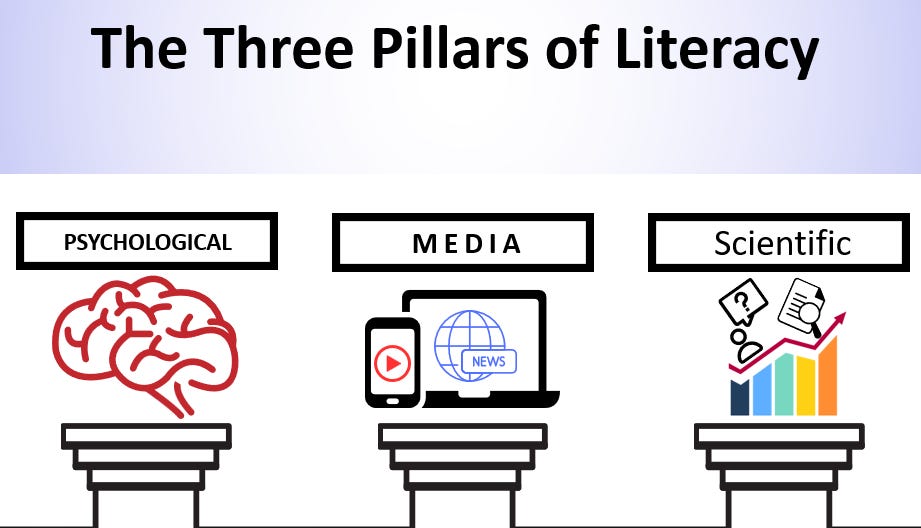
Rather than focusing on why misinformation spreads, we’ll shift toward how to apply these insights in real time, using three core skill areas that form what I’ve been calling the Three Pillars of Literacy:
Psychological Literacy
Recognize your cognitive biases, identity-driven motivations, and moments when you’re on “psychological autopilot.”
Information & Media Literacy
Evaluate sources, apply accuracy nudges, recognize framing, and spot manipulation, including AI-generated content.
Scientific Literacy
Understand how the scientific process works, the basics of research methods & statistics, and how to interpret scientific claims without getting swept up in misleading “breakthrough” headlines.
This course is intentionally hands-on and practice-focused, with short weekly lessons and structured exercises that help you evaluate information more clearly, recognize your biases, interpret scientific claims without getting lost in jargon, and build lasting habits for navigating our complex information ecosystem. It’s a shift from simply understanding misinformation to actively training your literacy muscles, and we’ll also cover how to share these skills with the people in your life who may benefit from them.
Who This Course Is For
Anyone who feels overwhelmed by the constant flood of online claims
Anyone curious about how to better understand their own biases
Anyone wanting to reason more effectively about scientific or political information
Anyone who enjoyed the previous course and wants the next step — something more applied, actionable, and skill-building
Anyone who wants practical media literacy tools they can use themselves and share with others
This course is for people who want to become calmer, more confident evaluators of information, not by memorizing fact-checks, but by strengthening the core literacies we all rely on. Feel free to invite a friend or family member who might benefit!
Included With Your Substack Subscription
This course is free for all current paid subscribers. New subscribers can join the course by signing up for an annual plan ($50).
Paid annual subscribers get full access to all video lessons, live Q&A sessions, assignments, and exercises.
Founding members get all of the above, and the ability to receive 1:1 calls and deeper guidance that functions almost like a mentorship layer.
I want this to feel like a meaningful investment in the people who make this work possible.
What We’ll Cover
A full syllabus, with readings, assignments, and optional deeper dives, will be published next week. Like my last Substack class, I will post a weekly video and also have a live Q&A the same week. Here is the general plan:
Week 1 — Psychological Literacy
How identities, networks, and cognitive shortcuts shape what we believe — and how to catch yourself in the moment.
Week 2 — Media Literacy
How to evaluate sources, read laterally, spot manipulation, and navigate an AI-driven media environment.
Week 3 — Scientific Literacy
How to interpret basic research methods, avoid being misled by statistics, identify red flags of research claims, and make sense of “breakthrough” claims.
Week 4 — Putting It All Together
A hands-on integration week using case studies, real headlines, and guided exercises, designed to help you apply these skills yourself and learn how to teach them to others.
Next Step: Syllabus Drops Next Week
This post is your early heads-up. The full syllabus will be out next week, complete with readings, exercises, and course structure, so you can see exactly what’s coming. Our first class is tentatively scheduled for the first week of January.
I loved teaching the last online course, and I’m looking forward to offering another one!
Is the course online, self paced, zoom etc? How long does each section take ( need to schedule time)?
Thank you, Am looking forward to this course.